
 EN
EN 公众号
公众号
 无障碍
无障碍
 字号:
字号:
 打印
打印
主办 : 中国地质调查局 | 技术支持:自然资源综合调查指挥中心 | 网站标识码bm16000002 | 京ICP备2020044568号

(原标题:Geologist's inner passion unlocks Earth's eternal heat)
For nearly four decades, Wang Guiling's "office" has been the most volatile terrain on the planet, from the boiling geysers of Yunnan province to the high-altitude hot springs of the Xizang autonomous region and western Sichuan province.
Wang, a researcher at the Institute of Hydrogeology and Environmental Geology in Shijiazhuang, Hebei province, affiliated with the Chinese Academy of Geological Sciences, is fascinated with the origins of thermal heat.
"It's not just a landscape," said the 62-year-old, referring to his geological surveys. "It's a conversation the planet is having with itself."
At the core of Wang's work is one of humanity's most pressing questions: Where will our energy come from when fossil fuels run out?
"Solar energy is an inexhaustible cosmic energy source, while geothermal heat is Earth's eternal gift from within," he said. "As long as the sun shines and the planet keeps moving beneath our feet, these two will never run out."
Wang's passion for his work goes far beyond earning a salary, in fact, in the 1990s his institute struggled to do exactly that. "I never wavered. I genuinely love this work. It comes from inside," he said.
What that work looked like in the early days is almost unimaginable in the age of digital mapping technology. Tasked with producing comprehensive maps of geothermal resources, Wang spent five years developing his method so painstaking it bordered on obsession. Armed with nothing more than a set square and paper maps, he plotted by hand more than 2,000 hot spring and geothermal well locations across China.
"I'd go through records — province, county, village — then get down on the map with a ruler until I found the exact spot," he said. "I'd mark it, and then I'd imagine the terrain. What did it look like there? Why was the water hot?"
Wang said geothermal exploration is similar to medical diagnosis. First comes the equivalent of a CT scan — geophysical surveys that detect anomalies in electrical signals beneath the surface, hinting at different rock types and structures. Then comes the biopsy — a test well used to measure underground temperatures.
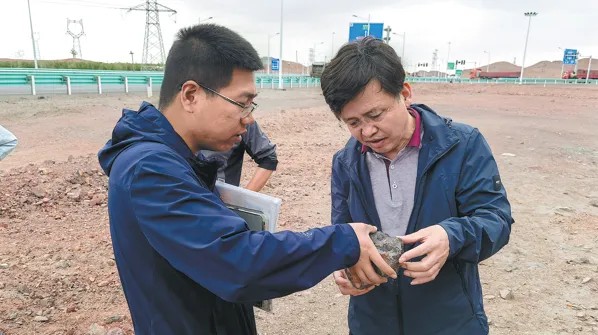
Wang Guiling (right) identifies a rock and determines its heat-storage features during a mission in the Xinjiang Uygur autonomous region in May last year.
Since 2011, the China Geological Survey has launched a national project to survey and evaluate geothermal resources. Led by Wang, the project has brought together hundreds of technicians from across the country to conduct systematic investigations of geothermal resources in each province.
Among the several types of geothermal resources, the potential of hot dry rock geothermal energy is especially pertinent. Wang and his team estimate that China's hot dry rock resources at depths of between 3 and 10 kilometers contain the heat equivalent of burning 856 trillion metric tons of coal.
"That figure is astronomically large. But it only tells us the heat is there. What we can actually extract is a different question," he said.
"To unlock it, we must artificially fracture the rock, pump cold water down, let it heat up in the cracks, and bring it back up again."
To Wang, his achievements do not come from individual brilliance alone. "Geothermal research is deeply interdisciplinary — geophysics, geochemistry, rock mechanics, hydrogeology, even mathematics and chemistry," he said.
"No person can be an expert in all of it. We need a team. And we need to give young people the conditions to settle down and really dig in.
"Working in geothermal exploration also requires the spirit of 'grinding a sword for 10 years'," he said.
用微信“扫一扫”,点击右上角分享按钮,
即可将网页分享给您的微信好友或朋友圈。